
Publications
Unsere Forschungs- und Vermittlungsergebnisse veröffentlichen wir in vielfältiger Form. Darunter sind einführende Publikationen im Internet, Aufsätze in Fachzeitschriften sowie Bücher, wovon sich manche eher an Spezialist*innen, andere an ein breites Publikum richten. Auf dieser Seite finden Sie einen Überblick über die Reihe, an der das Institut beteiligt ist, unsere neueren und früheren Sammelbände und Einzelstudien sowie weitere Publikationen unserer Mitarbeiter*innen.
Danubiana Carpathica. Yearbook of History and Culture in the German-Settled Regions of Southeastern Europe.
Danubiana Carpathica is published on behalf of the Commission for the History and Culture of Germans in Southeastern Europe, the Bukovina Institute in Augsburg, the Institute for Danube Swabian History and Regional Studies in Tübingen, and the Institute for German Culture and History in Southeastern Europe at LMU Munich. As a continuation of the *Südostdeutsches Archiv* 1 (1957) through 47 (2004), the yearbook is published by De Gruyter Oldenbourg in Berlin/Boston.
The Bukowina Institute is responsible for the 2020 and 2026 volumes.

Other Publications
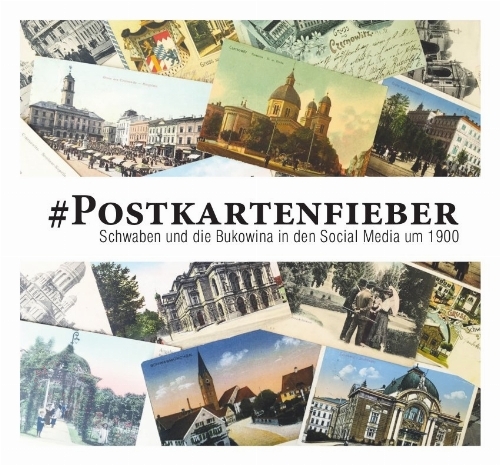
#Postcard Fever. Swabians and Bukovina on social media around 1900 (exhibition catalogue) Edited by Maren Röger and Christina Eiden (2019; in German)
The postcard seems like something from another era, but is it really so different from an Instagram post with a short message and a photo? Students at the University of Augsburg explored this question, amongst other things, and curated the exhibition #Postkartenfieber, which opened at the Bukowina Institute in 2019: Swabians and Bukowina on social media around 1900. Using historical postcards from Bukovina and Swabia, the exhibition illustrates how this unique medium shaped society during the so-called ‘golden age of the postcard’ at the end of the 19th century. The comparison between the very different regions of Bukovina and Swabia highlights the pan-European dimension of the ‘postcard’ phenomenon.

Previous publications
- Deportation of Bukovina Germans to the Soviet Union (2016; in German)
Like many Germans from Eastern and South-Eastern Europe, several thousand people from Bukovina were also deported to the Soviet Union in January 1945, where they were forced to perform hard labour. Since 1993, the Bukovina Institute has been running a research project into the causes, course and circumstances of the deportation, which has also examined the situation in the camps and, above all, the historical dimension of the deportation as experienced by those involved. Dr Ortfried Kotzian, former director of the Bukovina Institute, conducted numerous interviews in the region during the 1990s, which also shed light on the return of the deportees.
The findings of the team of authors – Ortfried Kotzian, Luzian Geier, a research fellow at the Bukovina Institute, and Ioana Scridon from Babes-Bolyai University in Cluj-Napoca/Klausenburg – are now available in book form – the first monograph on the subject for the Bukovina Germans.
- Bibliography of Bukovina (1966–2016; in German)
The publication of a multi-volume bibliography on Bukovina is one of the Institute’s most important academic undertakings. Dr Erich Beck, a native of Chernivtsi, has been meticulously collecting relevant works on the region of Bukovina in numerous languages since the 1960s. The first volume of the bibliography was published as early as 1966, and the seventh volume was published in 2016. Ioana Scridon of Babes-Bolyai University in Cluj-Napoca and Luzian Geier, a member of staff at the Institute, undertook the main editorial work, and the Institute funded the publication.
The six volumes of the bibliography comprise over 60,000 titles on the culture, literature and regional studies of Bukovina. The Beck Bibliography is the most comprehensive bibliography on the region of Bukovina and is of the utmost importance to current and future researchers.
- Kaindl Archive (in German)
Bukovina, or the ‘Land of Beech Trees’ on the eastern slopes of the Carpathians, was and remains a land situated between East and West. Partnership and tolerance characterised the lives of the population living between the Dniester and the Golden Bistritz, which comprised Ukrainians (Ruthenians), Romanians, Jews, Germans, Poles, Hungarians, Slovaks, Armenians, Lipovans and Hutsuls. In 1875, the south-easternmost German-speaking university in Europe opened its doors in the regional capital, Czernowitz. It produced Raimund Friedrich Kaindl, the historian of the ‘Carpathian Germans’ and a pioneer of academic folklore studies, after whom this journal is named.
Nationalism and communism destroyed the ‘Switzerland of the East’ in the 20th century. Through the Kaindl Archive, the Bukovina Institute in Augsburg aims to emphasise Bukovina’s European character and to harness the experiences of different peoples and ethnic groups living together in Central Europe across all fields of science, research, culture and literature for the ‘Vision of Europe’.
The Bukovina Institute is supported by:
The Bukovina Institute is supported by:




Bukowina-Institut
An der Universität Augsburg
Alter Postweg 97a
86159 Augsburg
86159 Augsburg
Opening hours
Montag bis Donnerstag
8:30-16:00 Uhr
8:30-16:00 Uhr